Hello everyone,
One thing I really like about Petfood Advisor is the idea that there is no “perfect food” for every dog or cat. It seems much more realistic than universal rankings.
This made me wonder:
How can I customize Petfood Advisor criteria for my own pet?
For example, can users prioritize specific factors depending on their animal’s needs, such as:
* lower carbohydrates,
* higher protein levels,
* digestive sensitivity,
* indoor lifestyle,
* senior age,
* sterilized cats,
* ingredient preferences,
* calcium/phosphorus balance,
* or specific analytical values?
I also wonder whether the platform can help users compare foods differently depending on their priorities instead of applying the same evaluation logic to every product.
For instance, a highly active working dog and an indoor senior cat obviously should not be analyzed in exactly the same way.
Does Petfood Advisor aim to become more of a personalized decision-support tool rather than a universal scoring platform?
I think this approach would make much more sense because pet nutrition appears far more individualized than many social media rankings suggest.
Looking forward to learning more about how experienced members use the platform.
Emily
How can I customize Petfood Advisor criteria for my pet?
-
j.channasse
- Posts: 7
- Joined: Thu May 21, 2026 3:36 pm
-
petfood advisor
- Site Admin
- Posts: 51
- Joined: Mon Apr 27, 2026 2:01 pm
Re: How can I customize Petfood Advisor criteria for my pet?
Hello Emily,
This is actually one of the main goals behind the Petfood Advisor project.
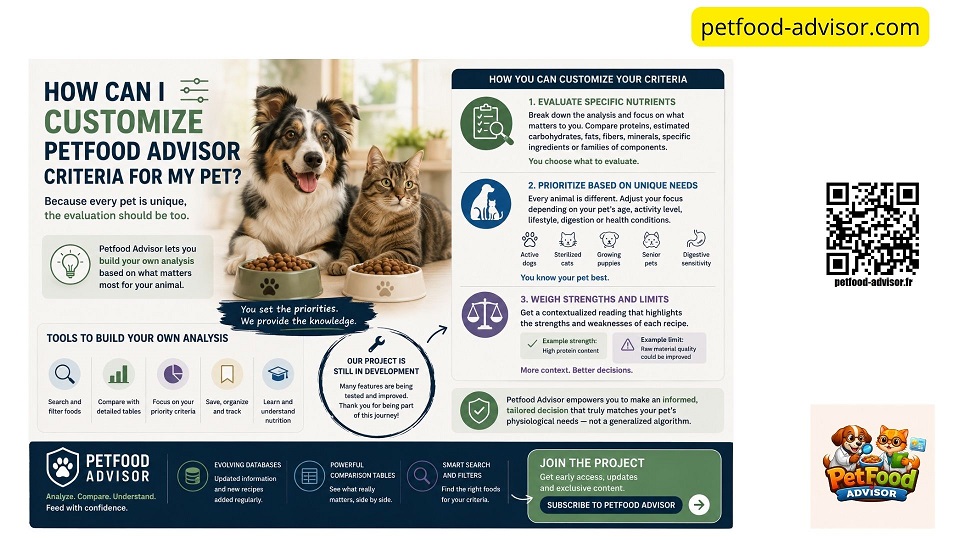
Unlike applications that impose a fixed and opaque universal ranking, Petfood Advisor is designed to help users build their own interpretation based on their pet’s specific needs and priorities.
The project is still evolving and many advanced customization features are currently under development, but the philosophy is already very different from traditional “one score for everyone” systems.
The idea is simple:
instead of forcing all foods into the same algorithm, Petfood Advisor aims to provide evolving databases, comparison tables, filters, and analysis tools that allow you to focus on the criteria that matter most for your own animal.
For example, users can already begin comparing products according to measurable values such as:
* proteins,
* estimated carbohydrates,
* fats,
* fibers,
* minerals,
* ingredient composition,
* dry matter values,
* calcium/phosphorus ratios,
* or specific nutritional characteristics.
This approach is important because every pet has a unique profile.
An active working dog, a sterilized indoor cat, a growing puppy, a senior animal, or a pet with digestive sensitivities should not automatically receive the same nutritional interpretation.
Rather than producing a simplistic “good” or “bad” verdict, the goal is to provide a contextualized analysis showing both strengths and limitations of a recipe.
For example:
a kibble may appear interesting for its high protein level, while another tool may help users notice that the quality or origin of certain raw materials deserves closer examination.
The objective is therefore not to replace consumer judgment, but to improve it through transparent information and flexible comparison tools.
In the future, the platform aims to become even more personalized, allowing users to progressively refine searches and evaluations according to:
* lifestyle,
* age,
* activity level,
* nutritional priorities,
* ingredient preferences,
* digestion,
* and other individualized criteria.
Petfood Advisor is still a growing project, and many features are being tested and improved continuously. The long-term ambition is to create a decision-support ecosystem centered on transparency, critical thinking, and personalized analysis rather than viral scoring systems.
Thank you for this excellent question because it touches the core philosophy of the platform.
This is actually one of the main goals behind the Petfood Advisor project.
Unlike applications that impose a fixed and opaque universal ranking, Petfood Advisor is designed to help users build their own interpretation based on their pet’s specific needs and priorities.
The project is still evolving and many advanced customization features are currently under development, but the philosophy is already very different from traditional “one score for everyone” systems.
The idea is simple:
instead of forcing all foods into the same algorithm, Petfood Advisor aims to provide evolving databases, comparison tables, filters, and analysis tools that allow you to focus on the criteria that matter most for your own animal.
For example, users can already begin comparing products according to measurable values such as:
* proteins,
* estimated carbohydrates,
* fats,
* fibers,
* minerals,
* ingredient composition,
* dry matter values,
* calcium/phosphorus ratios,
* or specific nutritional characteristics.
This approach is important because every pet has a unique profile.
An active working dog, a sterilized indoor cat, a growing puppy, a senior animal, or a pet with digestive sensitivities should not automatically receive the same nutritional interpretation.
Rather than producing a simplistic “good” or “bad” verdict, the goal is to provide a contextualized analysis showing both strengths and limitations of a recipe.
For example:
a kibble may appear interesting for its high protein level, while another tool may help users notice that the quality or origin of certain raw materials deserves closer examination.
The objective is therefore not to replace consumer judgment, but to improve it through transparent information and flexible comparison tools.
In the future, the platform aims to become even more personalized, allowing users to progressively refine searches and evaluations according to:
* lifestyle,
* age,
* activity level,
* nutritional priorities,
* ingredient preferences,
* digestion,
* and other individualized criteria.
Petfood Advisor is still a growing project, and many features are being tested and improved continuously. The long-term ambition is to create a decision-support ecosystem centered on transparency, critical thinking, and personalized analysis rather than viral scoring systems.
Thank you for this excellent question because it touches the core philosophy of the platform.
- Attachments
-
- How can I evaluate the digestibility of pet food ingredients3.jpg (197.84 KiB) Viewed 779 times