Hello everyone,
I keep hearing that carbohydrates are one of the most controversial topics in pet nutrition.
At the same time, many people online claim that the pet food industry hides the real carbohydrate content of kibble because these values are often not displayed directly on the packaging.
This made me wonder:
How do I evaluate carbohydrates using Petfood Advisor tools?
I noticed that many labels show proteins, fats, fibers, ash, and moisture, but rarely provide a clear carbohydrate percentage. Yet carbohydrates seem to play a major role in many online debates about kibble quality.
How does Petfood Advisor estimate or analyze carbohydrate levels when manufacturers do not always display them clearly?
I also read that some websites and influencers use simplified “low carb = good” shortcuts, while others completely ignore carbohydrate estimation altogether.
Can Petfood Advisor help users:
* compare estimated carbohydrate levels,
* understand dry matter values,
* interpret the context behind these numbers,
* and avoid misleading conclusions based only on marketing claims or viral social media posts?
I would also like to know whether carbohydrate analysis should always be interpreted together with other criteria such as protein quality, digestibility, fat levels, mineral balance, and ingredient composition.
It sometimes feels like carbohydrates are either exaggerated or intentionally hidden depending on who is discussing pet food online.
Looking forward to understanding how experienced members approach this topic more objectively.
Emily
How do I evaluate carbohydrates using Petfood Advisor tools?
-
j.channasse
- Posts: 7
- Joined: Thu May 21, 2026 3:36 pm
-
petfood advisor
- Site Admin
- Posts: 51
- Joined: Mon Apr 27, 2026 2:01 pm
Re: How do I evaluate carbohydrates using Petfood Advisor tools?
Hello Emily,
This is an extremely important topic because carbohydrates are one of the least transparent areas of commercial pet food labeling.
In many countries, manufacturers are not required to display carbohydrate percentages directly on the packaging. Most labels only provide:
* proteins,
* fats,
* fibers,
* ash,
* and moisture.
As a result, consumers often cannot immediately see the estimated carbohydrate content of a kibble, even though carbohydrates may represent a significant part of the recipe.
This is one reason why carbohydrate discussions have become so controversial online.
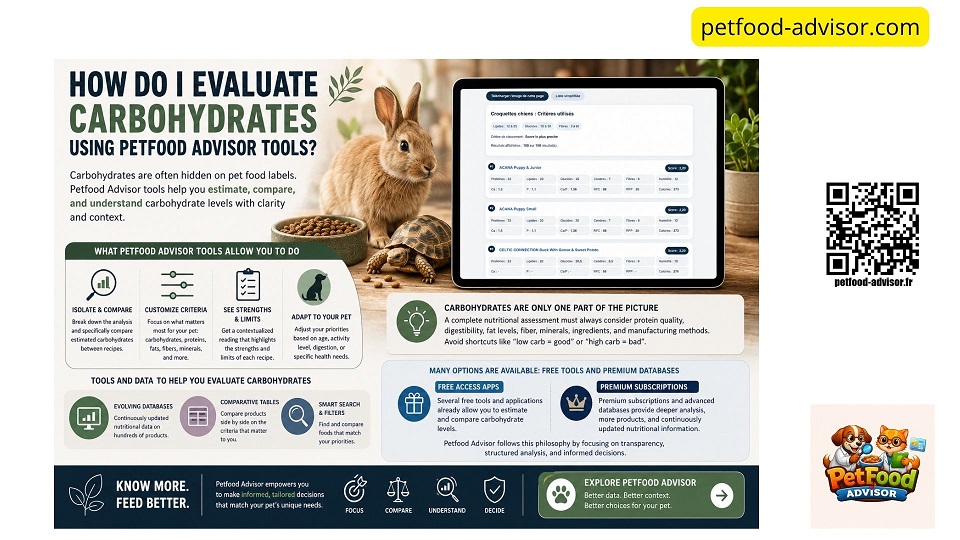
Petfood Advisor tools help users approach this issue more objectively by allowing them to analyze recipes through evolving databases, comparative tables, filters, and search tools rather than through simplistic universal scores.
Instead of relying on a “good” or “bad” algorithm, users can isolate and compare estimated carbohydrate levels between products according to their own priorities and their pet’s specific needs.
The platform also encourages a more contextualized interpretation of carbohydrates.
For example:
a lower carbohydrate percentage does not automatically mean a food is nutritionally superior.
Protein quality, digestibility, ingredient sourcing, fat levels, mineral balance, fiber composition, manufacturing methods, and the overall nutritional profile also matter enormously.
One of the goals of Petfood Advisor is therefore to avoid the simplistic shortcuts frequently seen on social media such as:
“low carb = automatically healthy”
or
“high carb = automatically dangerous.”
Nutrition is much more nuanced than that.
Another important point is that carbohydrate estimation itself often requires calculations because the values are not explicitly declared on the label. This is why many comparison tools and databases calculate estimated carbohydrates from the analytical constituents provided by manufacturers.
Today, there are even free-access applications and online tools that allow consumers to estimate and compare carbohydrate levels between recipes. Premium subscriptions and advanced databases may also provide deeper analysis tools, comparison systems, contextual interpretation, and continuously updated nutritional data for thousands of products.
Petfood Advisor follows this philosophy by focusing on transparency and structured analysis rather than emotional rankings or viral scoring systems.
The objective is not simply to expose carbohydrates, but to help consumers understand how carbohydrate values fit into the overall nutritional balance of a recipe.
That difference is very important.
A nutritional analysis should always be interpreted globally, not reduced to a single percentage or a single marketing argument.
Thank you for raising this topic because many pet owners are actively searching for more transparent and reliable ways to understand pet food composition.
This is an extremely important topic because carbohydrates are one of the least transparent areas of commercial pet food labeling.
In many countries, manufacturers are not required to display carbohydrate percentages directly on the packaging. Most labels only provide:
* proteins,
* fats,
* fibers,
* ash,
* and moisture.
As a result, consumers often cannot immediately see the estimated carbohydrate content of a kibble, even though carbohydrates may represent a significant part of the recipe.
This is one reason why carbohydrate discussions have become so controversial online.
Petfood Advisor tools help users approach this issue more objectively by allowing them to analyze recipes through evolving databases, comparative tables, filters, and search tools rather than through simplistic universal scores.
Instead of relying on a “good” or “bad” algorithm, users can isolate and compare estimated carbohydrate levels between products according to their own priorities and their pet’s specific needs.
The platform also encourages a more contextualized interpretation of carbohydrates.
For example:
a lower carbohydrate percentage does not automatically mean a food is nutritionally superior.
Protein quality, digestibility, ingredient sourcing, fat levels, mineral balance, fiber composition, manufacturing methods, and the overall nutritional profile also matter enormously.
One of the goals of Petfood Advisor is therefore to avoid the simplistic shortcuts frequently seen on social media such as:
“low carb = automatically healthy”
or
“high carb = automatically dangerous.”
Nutrition is much more nuanced than that.
Another important point is that carbohydrate estimation itself often requires calculations because the values are not explicitly declared on the label. This is why many comparison tools and databases calculate estimated carbohydrates from the analytical constituents provided by manufacturers.
Today, there are even free-access applications and online tools that allow consumers to estimate and compare carbohydrate levels between recipes. Premium subscriptions and advanced databases may also provide deeper analysis tools, comparison systems, contextual interpretation, and continuously updated nutritional data for thousands of products.
Petfood Advisor follows this philosophy by focusing on transparency and structured analysis rather than emotional rankings or viral scoring systems.
The objective is not simply to expose carbohydrates, but to help consumers understand how carbohydrate values fit into the overall nutritional balance of a recipe.
That difference is very important.
A nutritional analysis should always be interpreted globally, not reduced to a single percentage or a single marketing argument.
Thank you for raising this topic because many pet owners are actively searching for more transparent and reliable ways to understand pet food composition.
- Attachments
-
- How do I evaluate carbohydrates using Petfood Advisor tools2.jpg (196.75 KiB) Viewed 802 times
